Dedicated MPPT supplies active DC loads first while surplus power can charge the battery.
SOLAR + BATTERY + EV CHARGING
Solar and storage for grid-limited charging sites.
EV Whale combines dedicated PV MPPT DC/DC, battery storage, a 1,500 V-class common DC bus and centralised charging output in a modular DC-coupled architecture.
Discuss your project →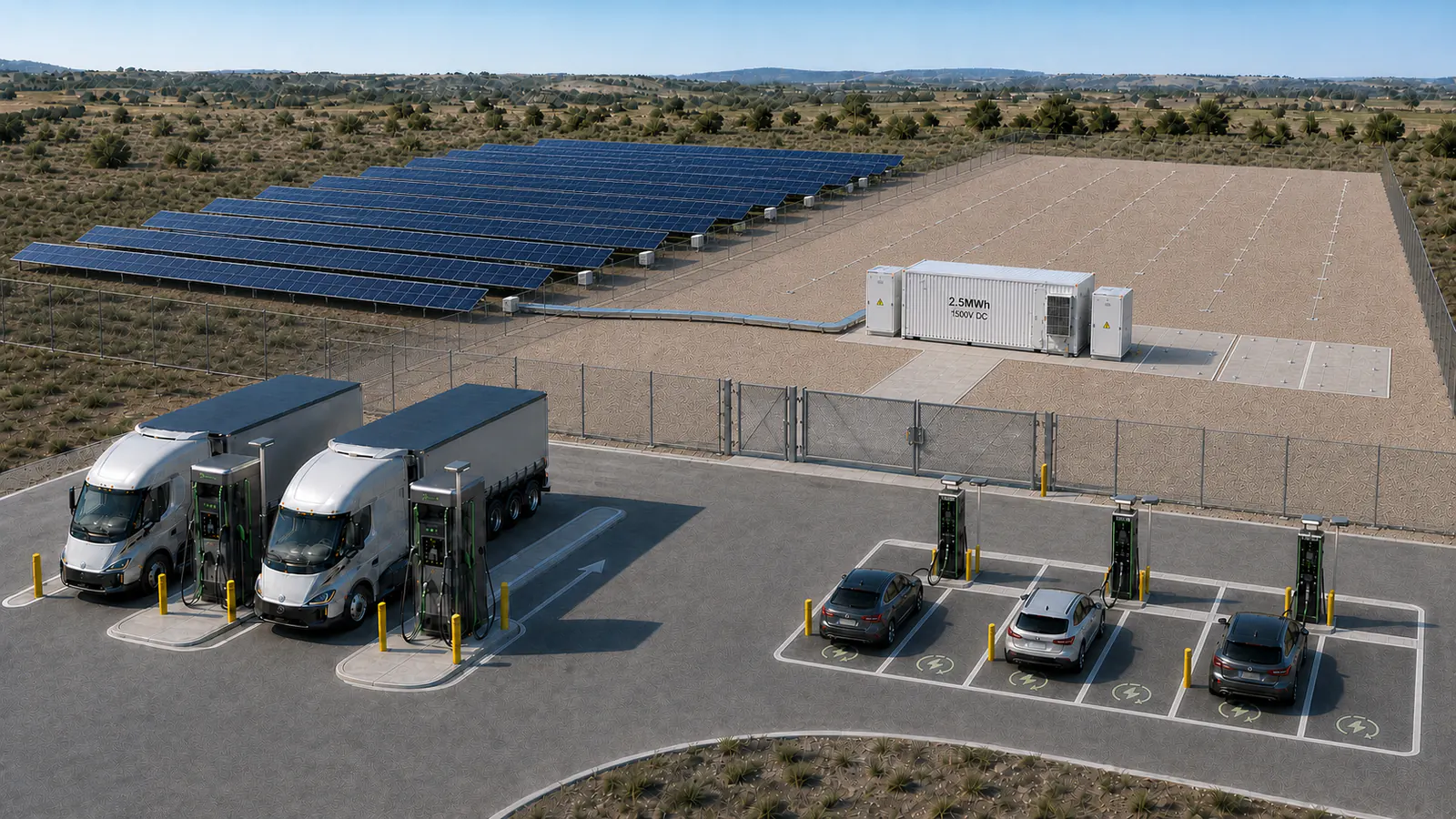
PROJECT CHALLENGE
Conventional charging can make the grid connection the project bottleneck.
- New high-power loads may exceed switchboard, incoming cable or local network capacity.
- Repeated AC/DC conversion adds equipment and conversion loss when the main sources and loads are DC.
- Fixed, tightly integrated equipment can make later maintenance and technology replacement expensive.
DELIVERY APPROACH
Coordinate generation, storage and charging on a common DC platform.
Bidirectional BIDC modules stabilise and support the bus during solar shortfall or night operation.
A centralised shared-power system dynamically allocates available power across the connected charging dispensers.
Grid, wind or diesel can connect through a separate transformer and AC/DC cabinet when required.
LIFECYCLE VALUE
Fewer conversion stages. Replaceable equipment.
PV equipment, the integrated DC bus and BIDC cabinet, battery containers and charging cabinets are separated so capacity, failures and technology upgrades can be managed by module.
FAQ
Questions project teams ask
Does solar power have to pass through the battery first?
No. The common DC bus can allow PV to support charging directly, with surplus power stored and the battery supplementing shortfalls.
Is the common bus fixed at 1,500 V?
No. It is a 1,500 V-class system. The target operating range must be confirmed with the battery, BIDC and DC-input loads.
Does the system eliminate all grid work?
Not automatically. It can reduce dependence on grid upgrades, but site, electrical and network studies remain necessary.