Check routes, parking time and energy needs. Allow for delays and detours.
HEAVY TRANSPORT
Megawatt-scale charging for trucks and buses.
For electric trucks, buses and other heavy-duty vehicles, EV Whale combines route planning, 1,500 V DC-class distribution, storage buffering and dynamic power allocation across charging dispensers.
Discuss your project →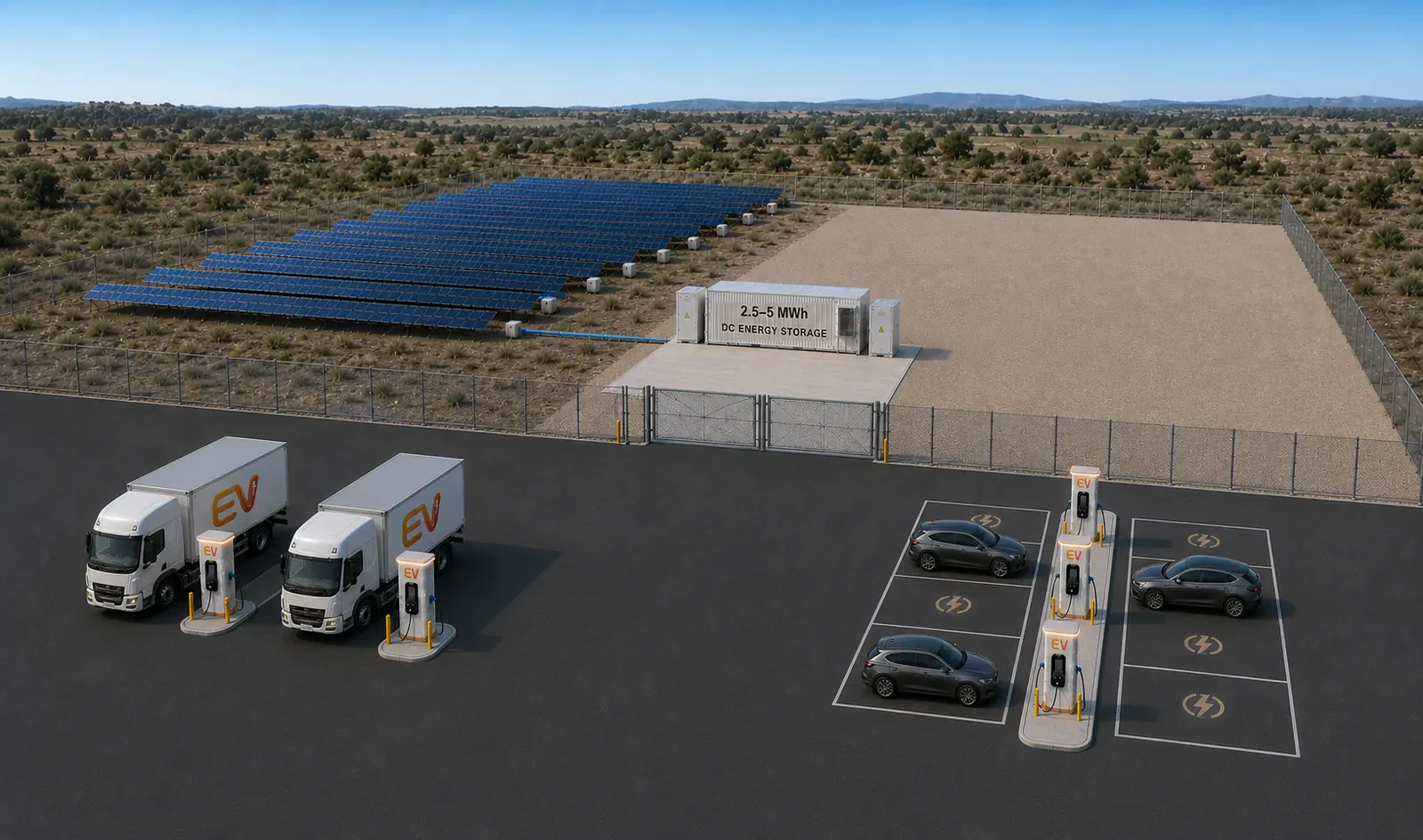
PROJECT CHALLENGE
Heavy vehicles need more energy during each stop.
- Route energy and payload can make passenger-car charging assumptions irrelevant.
- Several vehicles arriving together can create a power peak beyond the site connection.
- Turning paths, trailer access, queuing and safe separation must be designed with the electrical system.
DELIVERY APPROACH
Coordinate road operations and station power.
Allocate available station power dynamically instead of fixing each bay to one output rating.
Use project-sized storage and BIDC capacity to support charging when solar is low or the grid is limited.
Reserve feeders, cabinet capacity, cooling and communications for later charging-dispenser growth.
LIFECYCLE VALUE
High power without locking the site to one charger combination.
The centralised shared-power charging system and even-number dispenser layout can be configured by project. Output remains governed by available solar, storage, BMS, BIDC, busbar, protection and thermal limits.
FAQ
Questions project teams ask
Is 2.5MW always continuously available?
No. 1.2–2.5 MW is a target configuration range. Continuous output depends on storage size, SOC, temperature, PV contribution and complete-system derating.
Can passenger vehicles use the same station?
The platform can support lower-voltage vehicle systems when the final charging equipment and interfaces are designed for that compatibility.
Why use dynamic allocation?
It directs available station power to the vehicles that need it, rather than leaving power stranded behind a fixed bay rating.