Map vehicles, routes, energy use, arrivals, departures and operational redundancy.
FLEET DEPOT CHARGING
Charging that fits your fleet’s schedule.
We size chargers, solar and battery storage to match daily energy needs, parking time and available grid capacity.
Discuss your project →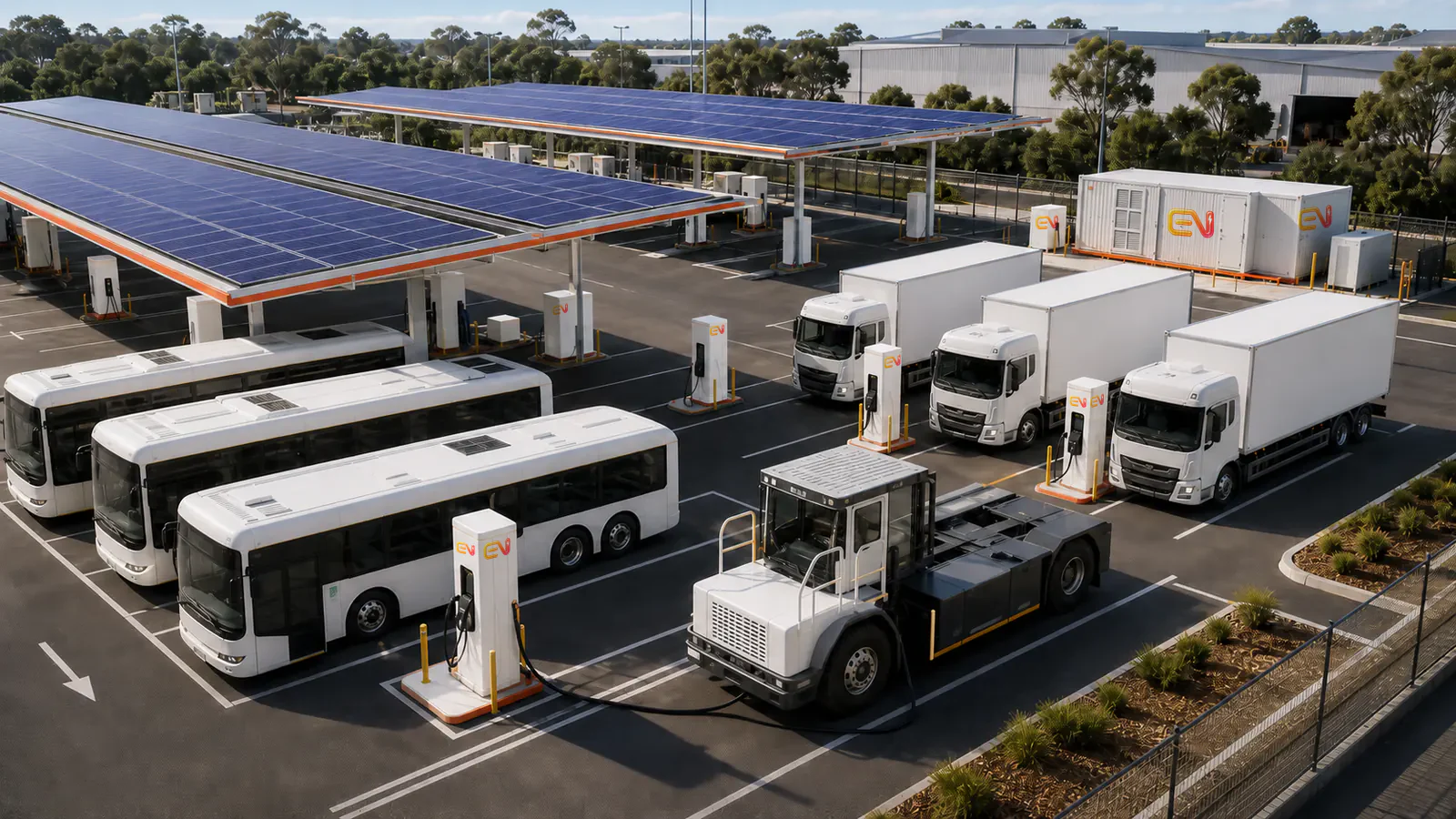
PROJECT CHALLENGE
Plan for daily energy use and departure times.
- Daily distance, vehicle type and payload determine how much energy each vehicle needs.
- Arrival and departure times determine how long each vehicle can charge.
- Existing switchboards and grid connections may not support simultaneous high-power charging.
DELIVERY APPROACH
A charging plan for your depot.
Review electrical capacity, solar resource, parking geometry and future fleet growth.
Start with the vehicles and shifts that create the clearest operational case, then expand modules and terminals.
Prepare one data layer for vehicles, bookings, energy, charging cost and driver access.
LIFECYCLE VALUE
Replace or expand the module that changes.
The DC bus and BIDC cabinet, battery containers, charging power cabinets and charging dispensers remain serviceable system boundaries. If battery capacity later degrades, the battery container can be replaced without discarding the entire charging system.
FAQ
Questions project teams ask
How is depot charging power calculated?
We calculate daily energy needs and charging time, then check vehicle charging limits and available site power.
Can the depot expand in stages?
Yes. Expansion must still re-check battery power, busbar, protection, cabling, cooling and EMS limits.
Does storage remove every grid constraint?
Storage can buffer site demand and support higher charging power, but every project still requires electrical, safety and operating studies.