
Through AC/DC conversion, within the site import limit.
PRELIMINARY PRODUCT CONCEPT · ENGINEERING TBC
Compact energy storage. High-power DC charging.
EV Whale Commercial combines battery storage, power conversion and charging controls for sites with limited grid capacity.
Discuss a pilot project →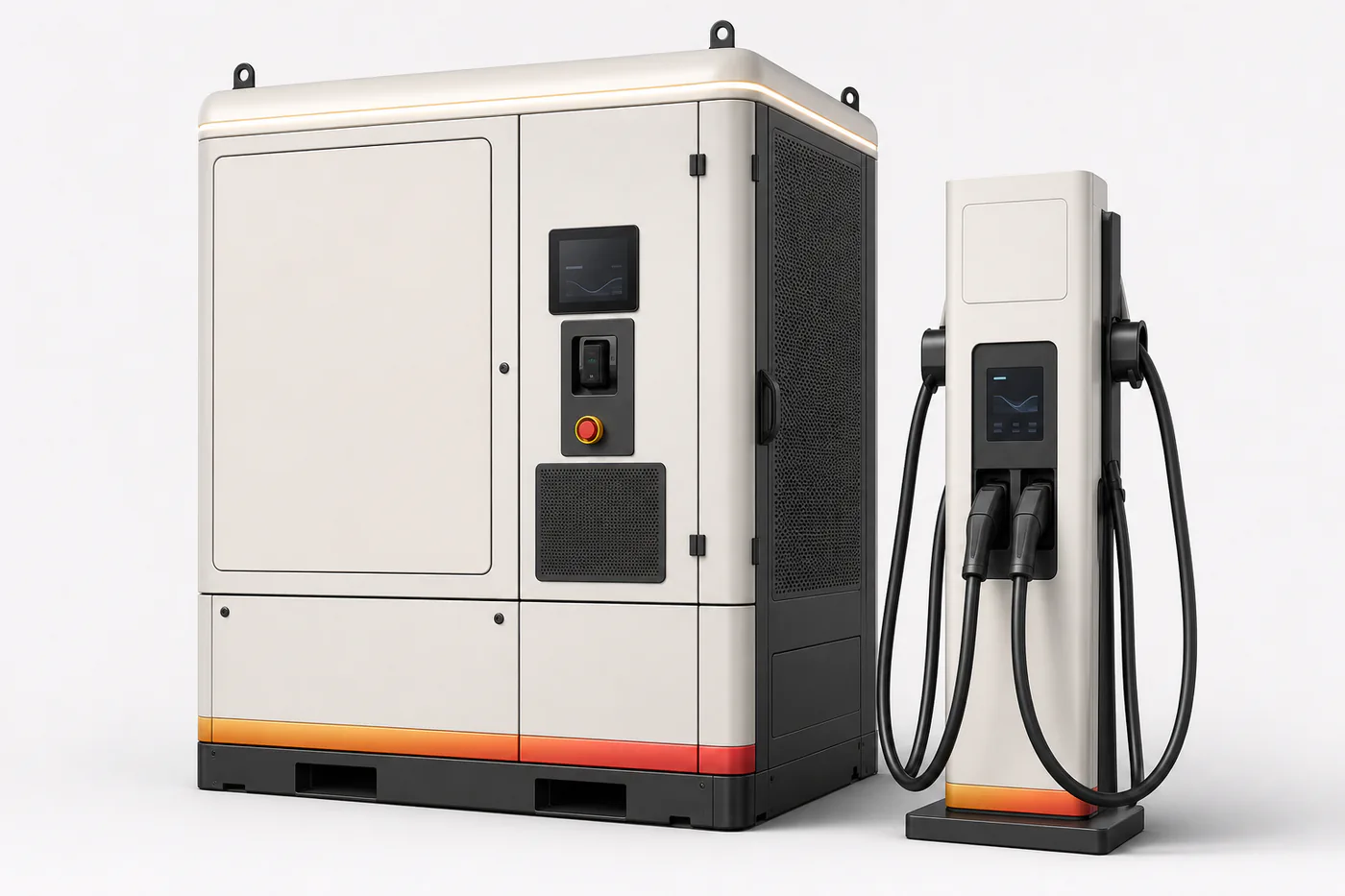
PRODUCT DESIGN LOGIC
Compact equipment with room for maintenance.
The concept envelope is defined around transport, foundation loading, equipment clearances and maintenance access at Australian commercial sites. Its structure, DC topology and modular boundaries are developed specifically for the EV Whale platform.
The main cabinet separates the battery, power and thermal-management, and low-voltage control/payment zones. A remote dispenser improves service access, parking layout and future expansion.
SYSTEM CONCEPT
Battery storage supplies extra power at charging peaks.
Through dedicated MPPT DC/DC conversion.
Solar can supply charging directly without first passing through the battery.
Store surplus energy and support charging peaks.
Dynamic power allocation → EV dispensers
Conceptual power flow. Interfaces, voltage, protection and control are confirmed during project design.
TARGET SPECIFICATION
For product definition and pilot discussions—not procurement, approval or construction.
Final values depend on cell and pack selection, DC/DC and charging modules, thermal design, fire safety, service clearances, foundation loading and certification.
Product statusPreliminary product concept; not a procurement or construction datasheet
Storage design targetApproximately 200–240 kWh configurable liquid-cooled LFP
Aggregate DC output targetApproximately 160–240 kW with dynamic sharing across two outlets
Site AC input targetApproximately 30–80 kW, configured by project
Optional PV inputApproximately 40–80 kW dedicated MPPT DC/DC
Vehicle output targetCCS2; approximately 200–1,000 V DC
Concept design envelopeApprox. 1.50–1.60 m W × 1.25–1.35 m D × 2.20 m H
Concept system massApprox. 2.8–3.5 t, depending on battery and power configuration
Backend & payment targetOCPP 2.0.1; optional EFTPOS, NFC, RFID and App
Certification & complianceRCM and applicable AS/NZS, IEC and fire-safety validation: engineering TBC
TO BE CONFIRMED IN THE RELEASED DATASHEET
Nominal and usable energy, SOC window and recovery time
Continuous and peak power, peak duration and temperature/SOC derating
AC and PV input ranges, efficiency, harmonics and standby loss
IP, IK, corrosion, noise, altitude and thermal management
RCM, applicable standards, fire-test scope and certificate numbers
System, battery-capacity, power-module, connector, labour and travel warranty
Maximum charging power and duration depend on usable battery energy, SOC, temperature, site grid and PV recharge, BMS/EMS limits, vehicle voltage and complete-system derating.
CO-DEVELOP THE PILOT